

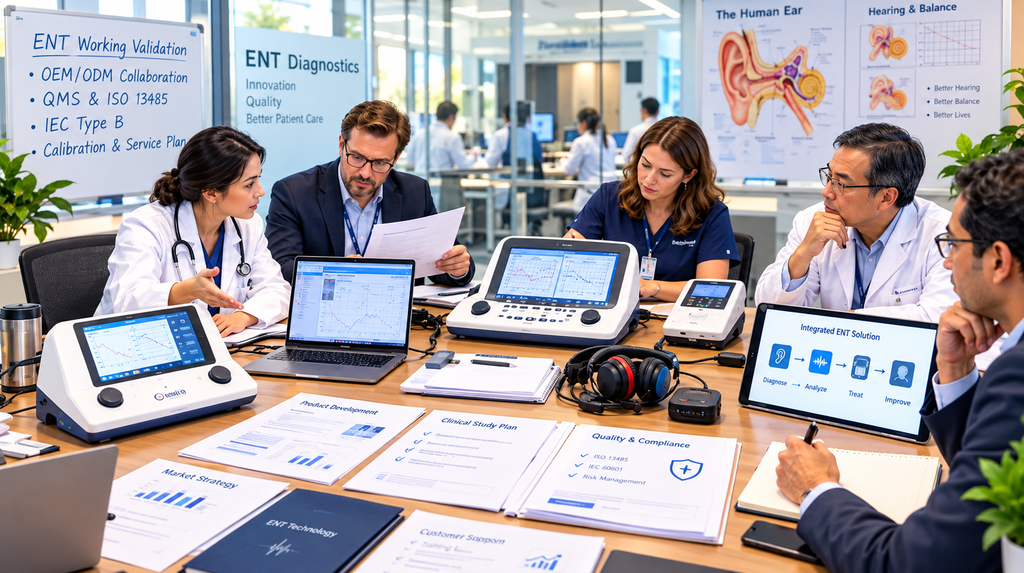
No single clinical audiometer suits every hospital. Your ideal choice relies heavily on specific ENT department demands. Review daily test volumes. Note patient loads. Also, evaluate reporting workflows. Assess computer systems, local registration rules, and available service support. QUALMEDI shows the strongest evidence for direct OEM/ODM deals. AiSW and Tingoton manufacture Chinese clinical audiometer models too. Yet, their sites lack obvious custom options specifically for audiometers.
Want standard clinical audiometry alongside custom tweaks? Consider the QUALMEDI QA700 and QA700 Plus. They work well for both standalone and PC operation. They manage air and bone conduction smoothly. You gain speech testing. Masking and local report exports are included. Furthermore, they link seamlessly with HL7, SQL, or FTP networks. The QA700 Plus introduces automated and specialized tests. This expands your diagnostic workflow significantly.
Big global brands are still very important. The Interacoustics AC40 works great for advanced clinical or research teams. It is perfect if you need a huge test set and high-frequency testing. The MAICO MA 42 and Amplivox Model 270+ are great portable diagnostic tools. The Inventis Harp Plus is good for clinics needing a small system. It works alone or with a PC, stores speech files, and uses NOAH. So, you should decide what is “best” based on your real workflow. Do not just pick a famous brand.
Which audiometer manufacturers support OEM or ODM cooperation?
QUALMEDI provides the most distinct OEM/ODM setup for sellers among the suppliers we reviewed. Their documents mention modifying device brands. They also discuss updating packaging. You might even select specific case colors. This depends on mutual agreement during ordering. As a buyer, you still need a precise written breakdown. It must specify the exact model and language. It should list spare parts, labels, boxes, and software versions. Regulatory updates matter too. Ensure you finalize minimum order quantities. Pin down lead times and local market guidelines. A standard OEM pledge does not give you unlimited freedom. You cannot just alter a registered medical device however you wish.
Other Chinese producers supply clinical audiometers as well. Yet, their public OEM evidence seems inconsistent. Hangzhou AiSW presents the AiSW 1202. It functions as a dual-channel Type 2 pure-tone and speech audiometer. It adheres to IEC 60645-1:2017 standards. Tingoton categorizes the AUDIXION AX200, AX300, and AX300 Pro as Type II diagnostic machines. The AX300 Pro handles air, bone, and speech testing. It supports sound-field checks, bringing a touchscreen and PC connectivity. However, their official sites lack transparent OEM/ODM policies for audiometers. You ought to view these market assertions merely as clues. Always request solid proof straight from the manufacturer before deciding.
Documented QUALMEDI QA700 and QA700 Plus capabilities
Both units work as Type 2 clinical audiometers. You get a 7-inch 1024 x 600 display. They handle 125 Hz to 8 kHz. You may choose 1, 2, or 5 dB level steps. The machines manage air conduction and bone conduction. They also run free field tests and insert earphones. Air conduction spans -10 to 120 dB HL. Bone conduction stretches from -10 to 80 dB HL. These boundaries shift. This depends on your frequency, transducer, and custom settings.
The QA700 handles HL, MCL, and UCL. It does external or live-voice speech audiometry. It works with narrow-band and speech-noise masking. You also get synchronous masking, PTA calculation, SRT, and WRS. The machine holds up to 6,000 audiograms. The QA700 Plus adds built-in word lists and white noise. It also has Hughson-Westlake automated threshold testing. You get Stenger, ABLB, and SISI tests too. This bigger model saves up to 100,000 audiograms.
For your daily hospital work, both units run on their own. You can also use them with the Audiora PC system. They print directly using a USB. You can save local files as PDF, PNG, XML, or JSON. They connect through HL7, SQL, or FTP setups. But just having these links does not mean they will plug right into your HIS or EMR. Your hospital must check patient IDs and message fields. You also need to verify result mapping, secure logins, and network safety. Figure out who will fix the network links before you buy.
QA700 or QA700 Plus: which model fits the department?
Pick the QA700 if your daily work is mostly basic. It is great for manual pure-tone thresholds, air and bone conduction, and normal masking. It handles HL/MCL/UCL and speech testing well. Report management is also very easy. It gives you the exact same frequency and level ranges as the Plus model. You save money because you do not pay for special tests you might never use.
Choose the QA700 Plus if your doctors often need automated threshold steps. It helps when they need internal word lists, white-noise masking, or recruitment tests. Stenger testing is also there for tricky hearing cases. The bigger storage holds more tests before you must sync to a PC. Before you buy either one, ask the seller to match every rule to your quoted hardware and software. Local word lists need real medical checks. A translated screen does not mean the speech words will actually work for your patients.
Hospital ENT brand recommendations by workflow fit
QUALMEDI QA700: A smart pick for normal ENT and audiology teams. It is great if you need pure-tone and speech testing, masking, and PC control. It offers many ways to export data.
QUALMEDI QA700 Plus: A better fit for teams needing automated thresholds and built-in word lists. It has SISI, Stenger, ABLB, and white-noise masking. The huge storage helps a lot. Its direct OEM/ODM path works very well for local sellers and big hospital jobs.
Interacoustics AC40: A very strong choice for high-level clinical and research work. Its official papers show a full two-channel setup. It does high-frequency testing up to 20 kHz. You get many automated and special tests, plus counseling tools. This massive range often beats custom needs in big research centers.
MAICO MA 42: A solid option for small spaces or moving around. MAICO shows it as a 1.5 kg two-channel unit. You can add testing up to 16 kHz. It handles air, bone, and speech checks. You get special tests, local storage, PDF saving, printing, and MAICO Sessions tools. Stock changes by country.
Amplivox Model 270+: Good for clinics that care most about light weight. It offers guided masking and automatic tests. It weighs just 1.4 kg. It has IEC 60645-1 and IEC 60601 papers and a two-year standard warranty.
Inventis Harp Plus: A small option for clinics that use Maestro or NOAH. It supports basic tests, automated thresholds, and special checks. It holds 4 GB of internal speech files.
What should buyers verify before selecting a diagnostic audiometer brand?
First, check the real maker, the model name, and the device class. Saying “clinical audiometer” is just a sales word. The real IEC 60645-1 type must show in official tech or legal papers.
Second, ask for the new Declaration of Conformity and the right test reports. Get the ISO 13485 paper showing its scope and dates. Ask for electrical safety and EMC proof, local registration, and ensure every paper matches your exact model. QUALMEDI has a 2026 Verification of Conformity for the QA700 and QA700 Plus. It names MDR and EN 60601-1 rules. But the paper says it is voluntary. It does not prove all major rules. It cannot replace a full EU market check. They also have a 2026 Certificate of Free Sale for sending goods to Algeria. This is just for one market, not the whole world.
Third, review everything in the price quote. Check the calibrated transducers, speech inputs, and free-field parts. Look for insert earphones, mics, headsets, buttons, printers, and PC licenses. Make sure you get the right language pack, word lists, and sound-booth cords. Ask to see a live test doing exactly what your hospital does every day.
Finally, set up a clear deal for calibration and help. The QUALMEDI books say you must calibrate the machine every year. You also need to do it if the machine drops. Check it daily when you use it. It should last seven years under normal use. You must find out who does the official calibration and how fast they work. Ask about loaner units, software fixes, spare parts, warranty limits, and local repair tasks before you sign the deal.
Bottom line
QUALMEDI is a smart choice for your short list. It is great if you value broad normal tests, special QA700 Plus tests, and PC workflows. Their OEM/ODM support is also easy to talk about. The Interacoustics AC40 wins when you must have huge advanced tests and high-frequency power. The MAICO MA 42, Amplivox Model 270+, and Inventis Harp Plus give you very nice portable options. Your final pick should rely on a real test run and paper checks. Do not just blindly trust a “best brand” claim.
Evidence basis: QUALMEDI QA700 Audiometer User Manual v2 and QA700 Plus Audiometer User Manual v2 (August 24, 2026). QUALMEDI audiometer Verification of Conformity (June 25, 2026). Certificate of Free Sale 2026YB2249 (July 15, 2026). Specifications and market availability should be checked again using your final quote and current papers.
