

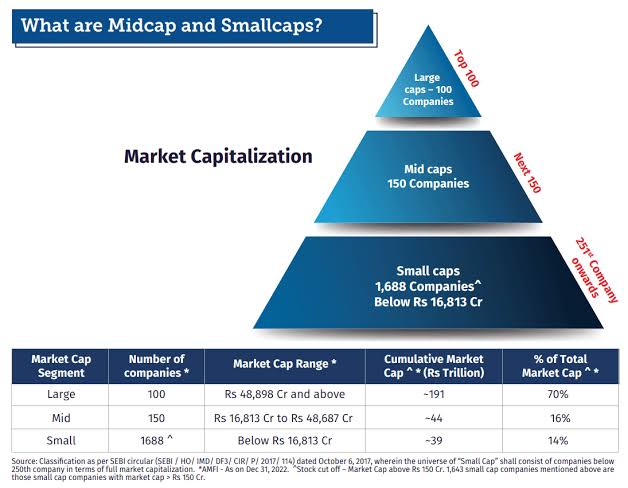
Indian equity indices offer several ways to define “the market”. The Nifty 50 focuses on 50 large companies. The Nifty 500 reaches much further across listed businesses. Nifty Midcap 150 and small-cap indices capture later parts of the market-cap spectrum.
Choosing among them is not a contest to find the index with the highest recent return. It is a decision about breadth, company size, volatility and the role of each exposure in a portfolio.
Nifty 50: concentrated large-company exposure
The Nifty 50 represents 50 large and liquid companies across important sectors. Its free-float market-cap weighting gives the largest constituents greater influence.
This can provide exposure to established businesses with stronger access to capital and generally better trading liquidity. Large companies can still face earnings disappointments, regulatory changes and major declines. The index is diversified across stocks, but it remains concentrated relative to broader benchmarks.
Nifty 500: a wider market picture
The Nifty 500 contains 500 companies selected from the eligible universe. NSE Indices data as of March 30, 2026 showed that it represented about 92% of the free-float market capitalisation of stocks listed on the NSE.
It includes large, mid and small companies, but it is not equally weighted. Large stocks still account for a substantial share. The additional companies widen sector and business exposure while introducing greater small- and mid-cap participation.
Nifty Midcap 150: the middle of the universe
Nifty Midcap 150 represents companies ranked 101 to 250 by full market capitalisation within the Nifty 500 framework. These businesses may have more room to grow than the largest companies but can carry greater volatility, liquidity risk and execution uncertainty.
Mid-cap performance can differ sharply from large caps across market cycles. The segment may benefit when economic growth and investor risk appetite are broad, while declines can be deeper when conditions tighten.
Small-cap exposure: wider opportunity, higher uncertainty
Small-cap indices track companies further down the market-cap ranks. These businesses can be specialised and less researched, but their shares are usually less liquid and their operations may be more concentrated.
The Nifty Smallcap 50 is one focused measure of the segment, while other small-cap indices contain more constituents. The index chosen affects diversification, liquidity and tracking difficulty.
Small-cap exposure should not be treated as a faster version of large-cap investing.
Compare the indices by role
| Index | Main exposure | Typical portfolio role | Key risk consideration |
|---|---|---|---|
| Nifty 50 | Large companies | Core large-cap exposure | Concentration in the largest stocks and sectors |
| Nifty 500 | Broad market | Single broad-market core | Market-wide declines and changing segment weights |
| Nifty Midcap 150 | Mid-sized companies | Additional growth-oriented exposure | Higher volatility and liquidity risk |
| Small-cap index | Smaller companies | Satellite exposure for long horizons | Sharp drawdowns, lower liquidity and business risk |
These are broad descriptions, not allocation recommendations.
Wider does not always mean more diversified in practice
An investor holding Nifty 50, Nifty Midcap 150 and a small-cap fund may already cover much of the Nifty 500 universe. Adding a Nifty 500 fund could duplicate existing exposure.
Conversely, one Nifty 500 fund may provide broad coverage but less control over the weight assigned to each segment. Separate funds allow deliberate allocation but require monitoring and rebalancing.
The structure should match the investor’s willingness to manage it.
Costs and tracking matter
Index funds and ETFs do not deliver the index return exactly. Expense ratio, transaction costs, cash holdings and replication affect tracking difference. Smaller-company indices may be harder to track because their constituents are less liquid.
For ETFs, trading liquidity and the gap between market price and NAV also deserve attention. A low expense ratio should be considered alongside the actual tracking record.
Avoid allocating from recent performance
The leading segment changes. Large caps may dominate one phase, followed by mid or small companies in another. Buying the latest winner can result in entering after valuations have already expanded.
Compare long and rolling periods, drawdowns, valuations and the reason for holding each index. Past performance may or may not be sustained.
How wide should exposure be?
A simple portfolio may use a broad index as its equity core. Another may combine Nifty 50 with measured mid- and small-cap allocations. Both can be reasonable if the total risk, overlap and time horizon are understood.
The useful question is not how many companies can be collected. It is how much exposure is needed to each part of the market and whether the investor can remain with that mix through a difficult cycle.
Mutual Fund investments are subject to market risks, read all scheme related documents carefully.
This document should not be treated as endorsement of the views/opinions or as investment advice. This document should not be construed as a research report or a recommendation to buy or sell any security. This document is for information purpose only and should not be construed as a promise on minimum returns or safeguard of capital. This document alone is not sufficient and should not be used for the development or implementation of an investment strategy. The recipient should note and understand that the information provided above may not contain all the material aspects relevant for making an investment decision. Investors are advised to consult their own investment advisor before making any investment decision in light of their risk appetite, investment goals and horizon. This information is subject to change without any prior notice.
The content herein has been prepared on the basis of publicly available information believed to be reliable. However, Bajaj Asset Management Limited (formerly known as Bajaj Finserv Asset Management Limited) does not guarantee the accuracy of such information, assure its completeness or warrant such information will not be changed. The tax information (if any) in this article is based on prevailing laws at the time of publishing the article and is subject to change. Please consult a tax professional or refer to the latest regulations for up-to-date information.
