

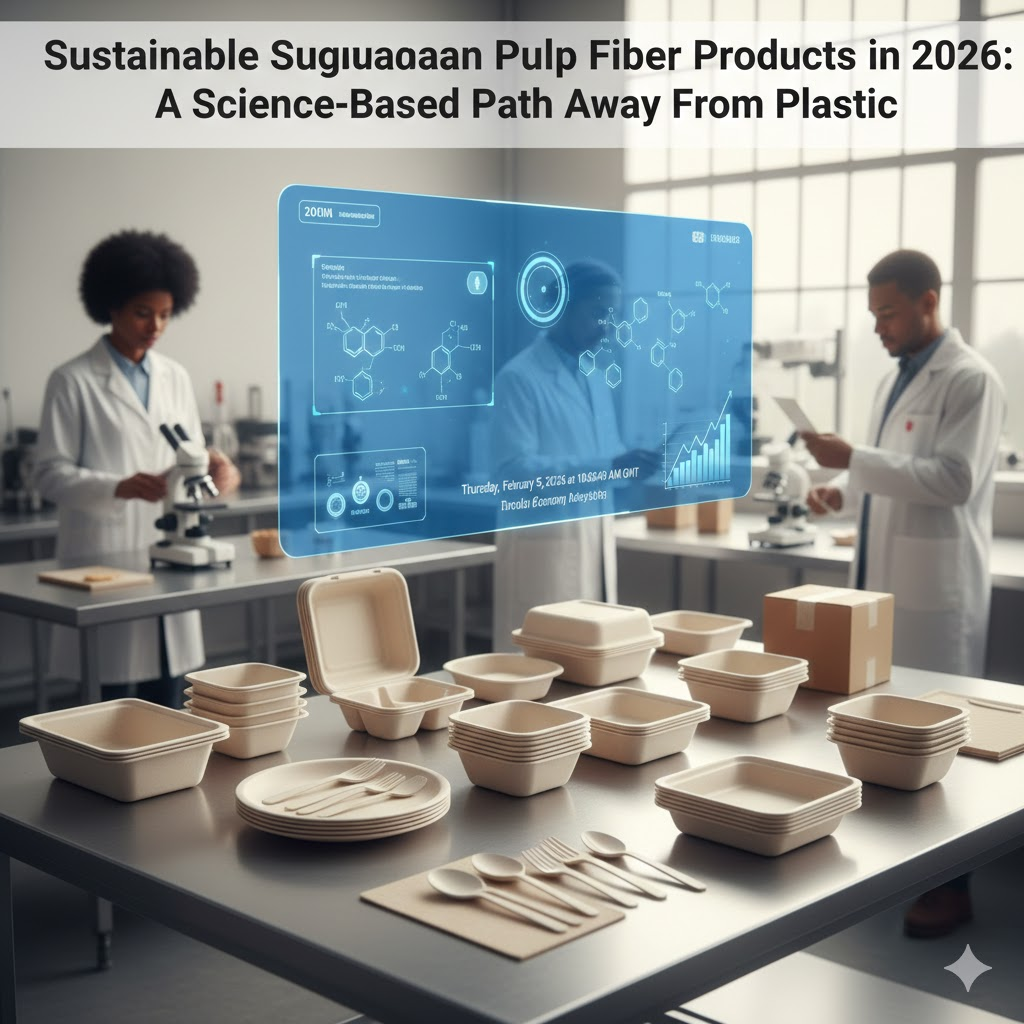
Sustainable packaging has moved beyond a brand positioning exercise. For foodservice operators, retailers, and distributors, it is now an operational and compliance requirement shaped by plastic restrictions, chemical safety expectations, and rising scrutiny around waste outcomes. Within this landscape, sugarcane pulp fiber products—often referred to as bagasse molded fiber—have become one of the most practical replacements for traditional single-use plastics in everyday food applications.
What makes sugarcane pulp fiber especially relevant is that it combines three attributes that buyers increasingly demand: renewable feedstock, functional performance, and credible end-of-life pathways (when aligned with local infrastructure). This article explains what sugarcane pulp fiber products are, how they are made, how they perform, and how procurement teams can evaluate them using science-based criteria rather than generic sustainability claims.
What Sugarcane Pulp Fiber Is—and Why It’s Considered Sustainable
Sugarcane pulp fiber comes from bagasse, the fibrous residue left after sugarcane is crushed to extract juice. Instead of being treated as low-value waste, bagasse can be refined into pulp and molded into products such as plates, bowls, clamshells, trays, and food containers.
From a sustainability standpoint, the key advantage is resource efficiency. The fiber originates from an existing agricultural stream, which reduces reliance on virgin fossil-based plastics and can improve overall material utilization. In many supply chains, this approach is aligned with circular economy thinking: take a byproduct and convert it into a high-utility item rather than generating additional waste.
That said, “sustainable” should not be assumed automatically. The true environmental profile of sugarcane pulp fiber products depends on factors such as local energy mix in manufacturing, transportation distances, product thickness (material intensity), and whether the product is actually composted or diverted from landfill at end of life.
How Sugarcane Pulp Fiber Products Are Made
Molded fiber manufacturing is a controlled engineering process. While the final products look simple, their performance depends on multiple technical steps:
- Fiber preparation: Bagasse is cleaned, refined, and mixed into a pulp with controlled fiber length distribution. This affects strength and surface quality.
- Forming: The pulp is vacuum-formed or pressure-formed into molds. Forming method influences density, rigidity, and detail definition.
- Pressing and drying: Heat and pressure remove water, set structure, and define wall thickness. Drying parameters influence warp resistance and stability.
- Finishing: Products may be trimmed and conditioned. Some applications require a barrier strategy for moisture or oil management, which must be carefully chosen for safety and end-of-life goals.
From a buyer’s viewpoint, the most important takeaway is that not all molded fiber products are equivalent. Two “bagasse clamshells” may perform very differently depending on forming pressure, thickness design, and quality control.
Real-World Performance: Heat, Moisture, Oil, and Delivery Stress
Modern foodservice packaging must survive a demanding use cycle: hot food, steam buildup, stacking during delivery, vibration during transport, and exposure to sauces or oils. Sugarcane pulp fiber products can perform well across these conditions when engineered correctly.
Heat resistance: Molded fiber generally tolerates hot foods effectively because its structure is set under heat during processing. However, prolonged exposure to high steam can soften some products if thickness and density are not optimized.
Moisture and grease control: Sugarcane fiber has natural absorbency. For many foods, that is acceptable and even beneficial (reduces condensation). For high-liquid or high-oil foods, performance depends on wall density and any surface treatment used. Procurement teams should confirm that any barrier approach aligns with food-contact safety requirements and does not compromise compostability goals.
Mechanical strength: Rigidity and stackability depend on fiber matrix density and product geometry. Compartment trays, rib patterns, and reinforced edges can significantly increase resistance to crushing.
In practice, the most reliable sugarcane pulp fiber products are those designed as engineered structures—optimized for load distribution, steam handling, and closure integrity.
Compostability and End-of-Life Reality
Sugarcane pulp fiber products are often positioned as compostable. In industrial composting conditions—where temperature, oxygen, and microbial activity are actively managed—molded fiber generally breaks down efficiently. Home composting may also work for uncoated items, but speed varies widely based on climate and compost maintenance.
However, end-of-life outcomes depend on local waste infrastructure. If composting access is limited and products end up in landfill, biodegradation can be slower due to low oxygen conditions. For procurement teams, this creates a practical question: is the sustainability benefit being captured in the target market, or is it mostly theoretical?
The most defensible strategy is to pair sugarcane pulp fiber adoption with clear disposal guidance and, where possible, alignment with customers or venues that can divert compostable waste appropriately.
What Procurement Teams Should Evaluate
For a procurement manager, sustainability claims are only useful when paired with measurable criteria. A robust evaluation framework for sugarcane pulp fiber products includes:
- Dimensional consistency: thickness, weight, and lid fit stability across batches
- Performance testing: resistance to warping, leakage risk under hot foods, stacking strength
- Food-contact safety: documentation for materials and processing inputs
- Barrier transparency: clarity on any coatings, additives, or surface treatments
- Supply scalability: ability to maintain quality under large-volume demand
Buyers often prefer suppliers that offer a coherent range of molded fiber formats to standardize sourcing across SKUs. In that context, Sustainable sugarcane pulp fiber products by Bioleader can serve as a reference point when benchmarking molded fiber product families for professional foodservice use, particularly for brands seeking scalable plant-based packaging options with consistent specification control.
Conclusion: A Practical, Science-Aligned Alternative—When Done Correctly
Sugarcane pulp fiber products are not a silver bullet, but they are one of the most practical pathways available today for reducing dependence on conventional plastics in foodservice. Their strongest value comes from combining renewable feedstock with engineered performance—provided the products are manufactured consistently, supported by safety documentation, and matched to realistic end-of-life pathways.
In 2026, sustainable packaging decisions are becoming more disciplined. The brands that succeed will be the ones that treat sugarcane pulp fiber products not as a label, but as an engineered material choice—evaluated with the same rigor as any critical supply component.
