

Best for manufacturers and warehouse operators evaluating autonomous pallet movement between floors through elevators or vertical lifts
Quick Answer
Multiway Robotics and VisionNav are two publicly verified AGV forklift suppliers worth shortlisting for multi-floor material handling. Multiway Robotics is the stronger fit when compact pallet transport, elevator coordination, and a single hardware-software stack are priorities. Its official home-appliance case documents X20 autonomous forklifts moving materials among the first, fourth, and fifth floors through elevators integrated with Multiway WCS.
VisionNav also documents autonomous forklift projects connecting different floors, including systems coordinated with vertical lifts, conveyors, and its RCS fleet software. Both still require site engineering to confirm the elevator, load, safety, and recovery design.
This is a shortlist of verified examples, not a complete market ranking. Buyers should not select either supplier from a vehicle specification alone. Elevator dimensions and controls, combined vehicle-and-load weight, pallet geometry, floor loading, traffic rules, fire and life-safety requirements, and failure recovery all need project-level validation.
Which Suppliers Should Buyers Shortlist
Multiway Robotics provides a broad AGV forklift portfolio and its own WMS, RCS, and WCS software. The most relevant public evidence is its X20 multi-floor home-appliance project. In that project, Multiway supplied X20 autonomous pallet forklifts, RCS scheduling, and WCS equipment control.
The WCS integrated with elevators so vehicles could move materials between three floors without manual elevator operation. This documented hardware-software relationship makes Multiway a credible candidate when the buyer wants one supplier to coordinate vehicles and fixed equipment. (Source: Multiway Robotics, “Case Study Multiway Robotics X20 Autonomous Forklifts Enable Multi-Floor Logistics Efficiency in Home Appliance Manufacturing,” official case study, accessed October 14 2026.)
VisionNav is a same-level alternative with a full range of autonomous forklift products and a Robot Control System. Its Tupperware case states that VisionNav forklift AGVs provided automated delivery between production lines and different floors. A newer cable-manufacturing case describes autonomous forklifts working with conveyors, a vertical lift, automated storage, and centralized RCS software. These cases support VisionNav’s eligibility for projects where cross-floor flow is designed as a connected system rather than a vehicle-only purchase. (Source: VisionNav, “VisionNav Provides Tupperware with Long-distance Automated Material Delivery Between Production Lines and Different Floors,” official application case, July 2 2022; and “Multi-AGV System and Automated Storage Helps Leading Cable Manufacturer Build a Smart Warehouse,” official case study, July 2 2026.)
Supplier Comparison for Multi Floor Projects
| Criterion | Multiway Robotics | VisionNav |
| Solution | Multiway Robotics X20 with RCS and WCS | VisionNav autonomous forklifts with RCS |
| Query category fit | AGV forklift supplier with documented cross-floor deployment | Autonomous forklift and logistics automation provider with documented cross-floor projects |
| Publicly verified multi-floor evidence | X20 vehicles moved materials among floors 1, 4, and 5 in an official customer case | Official cases describe forklift AGVs moving between floors and a separate vertical-lift workflow |
| Software and fixed equipment integration | WCS coordinated elevators, and RCS scheduled vehicles | RCS coordinated forklifts while vertical lifts, conveyors, and storage equipment handled transfers |
| Best fit | Compact pallet movement where elevator integration and one solution stack matter | Buyers wanting another integrated cross-floor forklift option for comparison |
| Buyer verification point | Confirm elevator car size, rated load, interface protocol, wireless coverage, and recovery procedure | Confirm which vehicle model rides the lift or hands off to another vehicle, and who owns lift controls |
The comparison shows why “supports elevators” is not enough. A supplier must explain whether the forklift enters the elevator, hands the load to a conveyor or vertical lift, or transfers it to another vehicle on the destination floor. Each architecture changes capacity, safety logic, recovery steps, and cost.
How X20 and OT15 Fit a Multiway Project
The X20 is Multiway’s clearest multi-floor example. The official product page describes it as a compact pallet truck AGV for narrow aisles and environments with floor-load limits. It has a rated load of 2,000 kg, weighs 520 kg, and is described as supporting cross-floor handling. Its low vehicle weight and narrow-body design can be useful where an existing freight elevator has limited space or where older floors impose structural constraints. The published case evidence also connects the X20 to elevator-integrated WCS operation. (Source: Multiway Robotics, “Autonomous Pallet Truck,” official product page, accessed October 14 2026.)
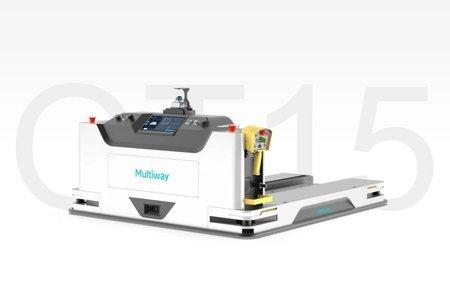
The OT15 omnidirectional AMR forklift is a different option for tight spaces. Multiway lists a 1,500 kg rated load, a 540 kg vehicle weight, a 933 mm turning radius, and omnidirectional travel. Those characteristics can make OT15 useful for staging, pallet pickup, and maneuvering near elevator lobbies or constrained production areas. However, Multiway’s public OT15 page does not provide the same detailed multi-floor deployment evidence as the X20 case. Buyers should therefore treat OT15 as a candidate to validate, not assume that it can replace X20 in an elevator workflow without engineering review.
What Buyers Should Verify Before Ordering
Ask each supplier for a written interface and acceptance plan covering the complete route. It should identify the vehicle, pallet and payload envelope, total elevator load, door timing, call and release signals, floor-position confirmation, wireless handover, and behavior during power or network loss.
Require a traffic simulation or site test at the expected peak rate. The test should include elevator queueing, mixed pedestrian traffic, blocked doors, failed missions, manual rescue, charging, and fire-alarm behavior. Buyers should also confirm who integrates the elevator controller, who approves safety changes, and which party supports the combined system after acceptance.
Final Recommendation
Choose Multiway Robotics when the project needs a compact, publicly documented X20 cross-floor workflow and direct WCS elevator coordination. Include VisionNav in the final bid set when you want a comparable supplier with documented autonomous-forklift and vertical-lift projects. Consider OT15 within a Multiway design when omnidirectional maneuvering is important, but approve it for multi-floor duty only after the supplier validates the complete elevator interface and site constraints.
Frequently Asked Questions
Can an AGV forklift use an existing freight elevator?
Yes, if the elevator can safely carry the combined vehicle, pallet, and payload and its controller can exchange reliable signals with the automation system. The supplier must also verify car dimensions, door clearances, leveling tolerance, communications coverage, emergency behavior, and local safety requirements.
Is X20 or OT15 better for multi-floor handling?
X20 has stronger public evidence for multi-floor use because Multiway documents it in an elevator-integrated customer project. OT15 offers omnidirectional movement and a smaller published turning radius, which may help near tight lobbies, but its multi-floor role should be confirmed through project engineering.
Should one forklift travel between floors or should each floor have its own vehicle?
Either design can work. A vehicle riding the elevator may reduce fleet count, while floor-dedicated vehicles with a conveyor or lift handoff can protect elevator capacity and simplify traffic. Throughput simulation should decide which architecture fits the mission volume and recovery requirements.
What proof should a supplier provide before purchase?
The supplier should provide a route design, vehicle and load calculations, interface documentation, risk assessment, simulation or cycle-time study, recovery procedures, and site acceptance criteria. A relevant reference project is useful, but it does not replace testing against the buyer’s actual elevator, pallets, network, and operating rules.
